About the Book
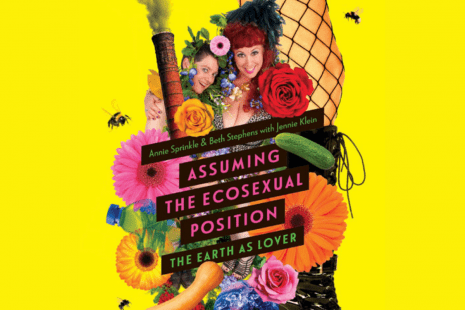
Assuming the Ecosexual Position: The Earth as Lover (University of Minnesota Press, 2021)
The story of the artistic collaboration between the originators of the ecosex movement, their diverse communities, and the Earth
In 2008, Annie Sprinkle and Beth Stephens married the Earth, which set them on the path to explore the realms of ecosexuality. Assuming the Ecosexual Position: The Earth as Lover (University of Minnesota Press, 2021) describes how the two came together as lovers and collaborators, how they took a stand against homophobia and xenophobia, and how this union led to the miraculous conception of the Love Art Laboratory.
What’s sexy about saving the planet? Funny you should ask. Because that is precisely—or, perhaps, broadly—what Annie Sprinkle and Beth Stephens have spent many years bringing to light in their live art, exhibitions, and films. In 2008, Sprinkle and Stephens married the Earth, which set them on the path to explore the realms of ecosexuality as they became lovers with the Earth and made their mutual pleasure an embodied expression of passion for the environment. Ever since, they have been not just pushing but obliterating the boundaries circumscribing biology and ecology, creating ecosexual art in their performance of an environmentalism that is feminist, queer, sensual, sexual, posthuman, materialist, exuberant, and steeped in humor.
Assuming the Ecosexual Position tells of childhood moments that pointed to a future of ecosexuality—for Annie, in her family swimming pool in Los Angeles; for Beth, savoring forbidden tomatoes from the vine on her grandparents’ Appalachian farm. The book describes how the two came together as lovers and collaborators, how they took a stand against homophobia and xenophobia, and how this union led to the miraculous conception of the Love Art Laboratory, which involved influential performance artists Linda M. Montano, Guillermo Gómez-Peña, and feminist pornographer Madison Young. Stephens and Sprinkle share the process of making interactive performance art, including the Chemo Fashion Show, Cuddle, Sidewalk Sex Clinics, and Ecosex Walking Tours. Over the years, they celebrated many more weddings to various nature entities, from the Appalachian Mountains to the Adriatic Sea. To create these weddings, they collaborated with hundreds of people and invited thousands of guests as they vowed to love, honor, and cherish the many elements of the Earth.
As entertaining as it is deeply serious, and arriving at a perilous time of sharp differences and constricting categories, the story of this artistic collaboration between Sprinkle, Stephens, their diverse communities, and the Earth opens gender and sexuality, art and environmentalism, to the infinite possibilities and promise of love.
Assuming the Ecosexual Position is available for purchase here with a 40% discount (using code MN88300) through December 1, 2021, as part of the National Women’s Studies Association conference sale.
Select Reviews
Tuned to the more than human, Annie Sprinkle and Beth Stephens have married widely and well, mating with the airs, waters, and places of Earth, inviting their companions into profligate kinning for earthly survival. They have taken me on their ecosexual journeys, rolling around with them on their theoretical and performative ground to get sufficiently soiled to be brave enough to join the old whore and the hillbilly in their radical practices of joy, love, and rage. Read this book, revel in its wacky seriousness, risk its call to transformative art and life.
— Donna Haraway, author of Staying with the Trouble: Making Kin in the Chthulucene
In Assuming the Ecosexual Position, Annie Sprinkle and Beth Stephens dance with diverse thinkers across theoretical, artistic, and planetary ground in their polyamorous love of the natural world. Sex can heal, and ecosexuality—taking the Earth as lover—is curative. Ecosexual art, activism, and other intimacies help quell society’s anthropocentric hierarchy so we might better nurture all of our relatives, both human and more-than-human.
— Kim TallBear, author of Native American DNA: Tribal Belonging and the False Promise of Genetic Science
About the Authors
Annie Sprinkle and Beth Stephens have been life partners and 50/50 collaborators on multimedia projects since 2002. They are authors of the Ecosex Manifesto and producers of the award-winning film Goodbye Gauley Mountain and Water Makes Us Wet, a documentary feature that premiered at documenta 14 and screened at MoMA in New York. Sprinkle is a former sex worker with a PhD in human sexuality. Stephens holds a PhD in performance studies and is founding director of E.A.R.T.H. Lab at University of California at Santa Cruz.
Jennie Klein is professor of art history at Ohio University. She is editor of Letters from Linda M. Montano and coeditor of Histories and Practices of Live Art and The M Word: Real Mothers in Contemporary Art.
Una Chaudhuri is Collegiate Professor and professor of English, drama, and environmental studies at New York University. She is coeditor of Animal Acts: Performing Species Today and coauthor of Ecocide: Research Theatre and Climate Change.
Paul B. Preciado is a philosopher and curator. His books include Testo Junkie: Sex, Drugs, and Biopolitics in the Pharmacopornographic Era and Countersexual Manifesto.